
Falling skies tarkov: a design note on a mood crossover
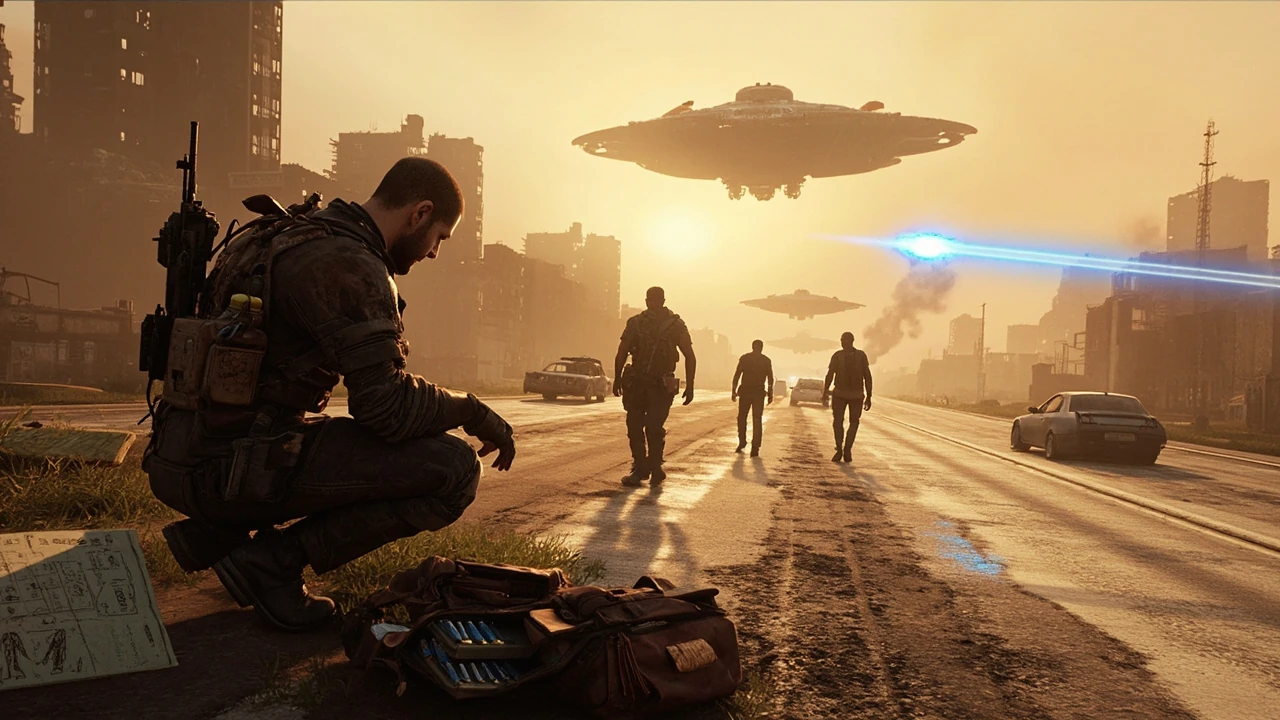
The phrase “falling skies tarkov” is best read as a creative brief, not a finished product. It points at the gap between two very specific works: a post-apocalyptic television serial about human survivors resisting an alien occupation, and a tactical, inventory-driven extraction shooter built around tension, scarcity, and perma-death risk. A useful editor or designer who hears this combination should ask what mood, mechanic, and production constraint they actually want to borrow, and what they would lose by forcing the two together. This article treats the topic as a GameDev design exercise: how the falling skies reference could inform a Tarkov-style project, where the analogy works, and where the show’s source material pushes back against the genre.
Readers looking for an actual game titled “Falling Skies” inside Escape from Tarkov, or a licensed crossover event, will not find one in this piece. There is no public Battlestate Games announcement linking the franchise to the show, and the show ended its broadcast run in 2015. What there is, however, is a coherent set of design questions worth answering, because both properties lean hard on the same feeling: small groups under pressure, losing things they cannot replace, and enemies that do not behave like ordinary soldiers.
What the show actually gives the designer
Falling Skies is a post-apocalyptic science fiction serial that ran on TNT for five seasons between 2011 and 2015. Its premise is the aftermath of an alien invasion that neutralized the world’s power grid, broke most militaries, and killed the overwhelming majority of the human population. Six months into the occupation, a paramilitary group of soldiers, veterans, and civilians tries to hold a slice of New England together and protect the next generation of children, several of whom have been harnessed by the alien overlords. That summary is enough to anchor several concrete design ideas without inventing lore.
For a Tarkov-style project, the relevant parts of the show are not the character arcs or the finale. They are the texture of daily survival in an occupied zone: salvaging from ruined suburbs, dealing with collaborators and resistance cells, the discipline of moving in small fire teams, and the persistent threat of an enemy that outguns the players. Each of those is something an extraction shooter can reproduce through level design, audio, AI behavior, and inventory rules, as long as the designer knows which elements to take literally and which to soften.
Why Tarkov is the natural destination for this mood
Escape from Tarkov, and the broader extraction-shooter genre it helped define, is built on a specific loop: enter a hostile map with a limited kit, loot, fight AI scavengers, hostile players, and bosses, and extract before losing everything. The genre’s emotional core is the tension between risk and reward, enforced by per-raid gear loss and long, open-ended firefights in dense, semi-realistic environments. That matches the show’s tone surprisingly well. Both works are quiet when they need to be, and loud only when the situation forces it.
The genre also has the production vocabulary to host a falling skies concept without bending it into something else. Tarkov already uses zone-based maps, scavenger AI that behaves more like desperate locals than trained soldiers, faction-specific gear pools, and a “found in raid” status that lets designers gate powerful items behind successful extractions. Those mechanics are exactly the right tools for staging raids where the players are outgunned, outnumbered, and surrounded by an enemy that does not respect the Geneva Convention.
A practical mood-to-mechanic mapping
The most useful thing a designer can do with this crossover is to write down the show’s defining features and decide, one by one, which ones map onto an existing Tarkov-style system and which ones would need new work. A short mapping makes the conversation concrete instead of aspirational. The table below collects the most common reference points and where they tend to land in an extraction-shooter design.
| Show element | What it does narratively | Closest extraction-shooter system | Implementation cost |
|---|---|---|---|
| Alien biomechanical dropships overhead | Constant, low-grade dread; reminder the sky is not safe | Dynamic aerial overpass with random AI patrols | High: new pathfinding, navigation mesh work, audio occlusion |
| Skitters and harnessed kids | Asymmetric threat; enemies that can turn civilians | New AI archetype with capture-and-convert behavior | Very high: animation, state machine, balance risk |
| Improvised militia weapons and armor | Visual identity of being under-resourced | Cosmetic skin pack and starter loadout tier | Low: art and attachment slots only |
| Six-months-after invasion decay | World that looks lived-in, not freshly bombed | Level art direction and prop scatter pass | Medium: art outsourcing and dressing rules |
| Collaborator and resistance cells | Moral ambiguity, friendly fire potential | Reputation system, trader tiers, and friendly NPC factions | High: data, UI, faction logic |
| Per-raid loss of squad members | Stakes that compound over a campaign | Permadeath or persistent wounded state | Medium to high: save data, UX, recovery tools |
| Hiding children and civilians | Non-combat objectives with timers | Optional side quests, escort payloads, timer events | Medium: quest framework, AI escort behavior |
The table is not a production plan. It is a way to keep the design conversation honest. Anything on the left that maps to a low-cost column can ship quickly as flavor. Anything that lands in the very high column needs a clear gameplay reason to exist, because the genre punishes mechanics that exist only for atmosphere.
Designing the enemy faction without aping the show
The single most expensive design decision in a falling skies inspired raid is the alien faction itself. The show’s aliens operate as a coordinated occupation force: they patrol in patterns, they have aerial overwatch, and they capture humans instead of simply killing them. That profile is hard to implement on a Tarkov-style budget, and it is also the part most likely to make the raid unfair if it lands badly.
A more realistic approach is to split the threat into two layers. The first layer is human: armed occupiers, conscripted militia, and local collaborators who behave much like the existing Scav archetype, with a heavier lean toward suppression and patrol routes than the more chaotic behavior of normal scavengers. The second layer is the alien overwatch: a small number of high-value, high-threat aerial or exo-skeletal units that show up only in certain raids, and that players learn to read through audio cues long before they see them. That division keeps the AI cost manageable and makes the aliens feel like the show’s aliens: rare, devastating, and worth planning around.
Audio is where this split pays off. A low ambient hum that shifts in pitch when an overwatch unit is overhead gives players the same creeping dread the show gets from its dropship shots, and it does not require new pathing, new meshes, or new netcode. The existing extraction-shooter audio stack can be extended with a per-raid state variable and a few looped beds. The risk is overusing it: if the hum is always on, it stops being a signal. If it is tied to a strict timer and a small chance per map, it remains a moment.
Map, weather, and time of day as the cheapest atmosphere tools
Before the team writes a single new AI behavior, the cheapest atmosphere comes from environment. A falling skies flavored Tarkov raid reads as “post-invasion suburb” through specific, repeatable visual choices: abandoned cars at intersections, household furniture dragged into fighting positions, civilian clothing on enemy corpses, and weather that has gone slightly wrong. None of that is mechanically novel, and all of it is expensive only in art hours.
| Atmosphere layer | Concrete prop or rule | Risk if pushed too far | Realistic cap |
|---|---|---|---|
| Suburban streets | Two-story houses with blown-out windows, porch barricades, lawn furniture | Reads as “war, not apocalypse” if too clean | One large neighborhood block per map |
| Weather | Persistent overcast, light ash, occasional amber horizon | Visibility problems that frustrate gunfights | One optional weather preset per map |
| Skybox | Distant alien craft silhouettes, contrails, no readable UI | Becomes a meme if too cartoonish | Fewer than five craft visible at any time |
| Civilian detail | Children’s toys, schoolbags, scattered photos, food cans past expiry | Tonal whiplash between horror and combat | Limit prop scatter to a dressing pass, not a quest |
| Sound design | Distant mechanical hum, intermittent distress signals | Player fatigue and audio fatigue | One cue per minute, gated by state |
The “realistic cap” column is the one most teams underweight. Falling skies tone has a high body count and a somber emotional register, and a 45-minute raid that opens with a child’s bicycle on a lawn is going to feel manipulative by the third encounter. The genre’s strength is its pacing. A map can carry one strong emotional beat per raid, maybe two, and the rest of the level should be honest extraction-shooter geometry.
Inventory and loadout, where the genre already does the work
The most pleasant surprise for a designer working in this space is how much of the show’s “under-equipped survivors” feeling is already encoded in extraction-shooter loadout rules. Tarkov’s secure container, insurance system, and per-raid gear loss together do most of the storytelling the show does with the militia’s battered rifles and field-stripped ammo. A player carrying a low-tier weapon, no armor, and a single magazine is, mechanically, in the same position as a show character scrounging a working AK in a dead soldier’s locker.
The interesting design question is not whether to lean into that, but how far to push it. Three loadout archetypes map cleanly onto the show’s factions:
- Militia rifleman. Low-cost rifle, basic chest rig, one or two magazines, scavenged meds. Reads visually as a Tom Mason type. Strong default for new players on the map.
- Tech scavenger. Higher-cost suppressed weapon, small secure container, no armor. Reads as the engineer types who keep the group’s comms alive. Higher risk, higher reward per kilo.
- Heavy. Improvised plate carrier, looted heavy weapon, slow movement, loud. Reads as the power-armor or anti-mech characters. Powerful in set-piece fights, punished by overwatch.
These archetypes do not require new weapons or new models. They require the team to label existing attachment slots, container sizes, and movement penalties in a way that telegraphs role. The genre already balances high-mobility and high-armor kits. The designer’s job is to make the falling skies fiction legible on top of that balance, not to re-invent it.
Quests and narrative scaffolding that fit the loop
One place Tarkov-style games regularly struggle is narrative. The per-raid loop is short, hostile, and information-poor by design, and long-form story arcs do not survive that. Falling For additional context, skies, in contrast, is a serial with multi-episode arcs, character continuity, and ongoing mysteries. Forcing a Tarkov raid to carry a multi-episode arc is a category error. What the genre can host is the texture of that arc: small narrative beats that survive because they are tied to objects, not to cinematics.
A workable list of in-fiction quest hooks, each of which can ship as a single raid objective without breaking the loop:
- Recover a lost radio from a named location and extract it alive. Pairs cleanly with the existing “find in raid” flag.
- Locate a specific child or civilian NPC who is hidden in a residential block. Becomes a short escort with a soft timer.
- Salvage a crashed dropship component for the engineers. Acts as a high-tier barter item gated behind a tough AI zone.
- Resupply an allied militia camp by depositing food and meds in a marked cache. Uses the existing container system, no new UI.
- Disrupt a collaborator supply line by destroying marked vehicles. Lets the team reuse existing explosive balance.
- Mark alien patrol patterns by placing beacons in dangerous zones. Becomes a soft “recon” quest that future raids benefit from.
None of these requires voice acting, cutscenes, or branching dialogue trees. They all live in the existing quest framework and reward players with the show’s currency: information, not XP. The show’s actual plot is best left to a codex, a trader monologue, or a post-raid debrief that respects the player’s time.
Production constraints to plan around
It is worth being honest about the production cost of this kind of crossover, because Tarkov-style games are already expensive to maintain. A falling skies themed expansion does not just add a map and a faction. It changes a few things that the genre treats as load-bearing.
- Player trust around permadeath. The show is built on characters who do not come back. Tarkov’s hardcore mode is the same way, and most players opt out. A falling skies raid cannot require hardcore without alienating the existing audience. The fix is a per-raid “wounded” state, not a perma-death toggle.
- Realistic violence and civilian presence. The show includes civilian casualties, child endangerment, and implied harm to non-combatants. The game cannot reproduce that without crossing review board and storefront rules. The fix is a hard rule: civilians exist as objects and audio, never as AI actors the player can harm.
- Netcode and AI density. Adding an aerial AI archetype with global patrol patterns can destabilize server tick rates. The fix is a low-density prototype with on-rail movement before any free-roaming behavior.
- Audio bandwidth. A persistent ambient hum plus patrol cues plus per-zone scav chatter can crowd the mix. The fix is a priority system, not more sounds.
- Brand and licensing risk. A show name in a live-service game title is a legal project, not just a creative one. The fix is to develop the design as a generic “alien occupation” theme and only attach the license once the gameplay is solid.
These constraints do not block the project. They shape it. A team that plans for them at the design stage can ship the atmosphere in one map and one faction without rewriting the core game. A team that ignores them will discover them in QA, which is where genre projects go to die.
Comparing two reference points honestly
Designers often talk about a falling skies Tarkov crossover as if it were a single thing. In practice, the show and the game sit at different points on the genre map, and the table below spells that out without making either side look bad.
| Axis | Show reference | Extraction-shooter reference | Reconciliation in a hybrid project |
|---|---|---|---|
| Threat model | Asymmetric, alien overwatch plus human collaborators | Symmetric between players, asymmetric against AI | Asymmetric against AI only; players remain the wild card |
| Stakes | Story-level permadeath for named characters | Mechanical permadeath for hardcore players only | Optional wounded state for everyone, hardcore unchanged |
| Time horizon | Multi-episode arcs | Per-raid loops of 20-45 minutes | Arc carried by trader dialogue and codex, not by raids |
| Inventory narrative | Improvised gear, named weapons, sentimental objects | Tactical kit, attachment optimization, insurance meta | Sentimental loadout items as cosmetic-only slots |
| Tone | Somber, family-focused, apocalyptic | Clinical, tactical, often cynical | Tone carried by environment and audio, not by writing |
| Audience | TV drama fans who tolerate sci-fi | PC shooter players with high time investment | Cross-audience event with tutorial parity and low entry tier |
Reading the table straight through, the most awkward column is the tone. The show is family-focused and somber. The genre is competitive and tactical. A hybrid project has to pick which one anchors the design, and the right answer is almost always the genre, because the genre is what the players actually paid for. The show’s tone can flavor the periphery without changing the center.
What a vertical slice would actually look like
A vertical slice is the cheapest way to test whether this crossover is worth the investment. A realistic first slice would contain a single mid-sized map, one militia-side and one collaborator-side NPC archetype, a single aerial overwatch AI on a fixed patrol, and a quest type that uses the existing find-in-raid status. The slice runs for a fixed two-week event with telemetry, not a permanent game mode, so the team can read real player behavior before committing to art, audio, and netcode changes.
The acceptance criteria for the slice should be specific and falsifiable. Useful criteria, in the order the team would actually check them:
- Average raid length stays inside the existing genre window of 20-45 minutes. A longer average means the atmosphere is over-staying.
- Survival rate against the aerial overwatch AI is non-zero but under 40 percent. Higher means the AI is not delivering dread. Lower means it is griefing.
- Quest completion rate is between 25 and 50 percent. The quest cannot be a side objective players ignore, and it cannot be a forced objective players resent.
- Audio cue recall, measured by telemetry on pause-on-cue events, exceeds 30 percent. Below that, the cue is decorative.
- Refund and review spikes on the first 72 hours are within the studio’s normal event band. Outside the band, the design is misfiring with the audience.
Each of these is a hard signal. If the slice fails two of them, the project either needs a design change before continuing, or it should be shelved in favor of a different theme. The vertical slice exists to make that decision with data, not vibes.
Risk register: what is most likely to go wrong
It is worth listing the failure modes explicitly, because extraction-shooter projects are unforgiving when they ship the wrong feature. The risk register below uses simple, sortable categories and does not invent numbers.
| Risk | What it looks like in QA | Mitigation |
|---|---|---|
| Tone mismatch | Reviews mention the show’s grim tone as “off” for a shooter | Limit somber props to one zone per map; keep combat zones visually neutral |
| AI overwatch griefing | Players report being killed without warning or counterplay | Telegraph the AI with audio and a visible patrol arc; cap spawns per raid |
| Quest fatigue | Quest completion drops after the first 24 hours | Rotate quest types weekly; gate rewards behind a low-friction track |
| Performance regression | Frame time spikes when the overwatch AI is on a path near the player | Cap simultaneous AI behaviors; reduce LOD cost on the aerial mesh |
| Audio fatigue | Players mute in-game audio in community guides | Cut ambient hums during combat; gate cues to a per-raid state machine |
| Brand confusion | Players believe the show is a new game or a licensed expansion | Use a generic “occupation” theme; do not use the show’s title in UI |
| Storefront flags | Civilian AI or child audio flagged by certification | Replace civilians with props; remove child voice lines entirely |
The two highest-leverage mitigations are audio gating and civilian-prop substitution. Both are cheap, both are reversible, and both protect the project from the kind of review that takes weeks to recover from. The lower-leverage mitigations, like brand confusion, can wait for the post-event retrospective.
How a producer would scope the project
Once the vertical slice is approved, the project has to be scoped in a way that respects the live-service calendar. A realistic scope for a single event or seasonal update, sized to a small team with art support, would split the work into three tracks: art and audio, AI and netcode, and quest and progression. Each track can ship in parallel once the slice is signed off, and each has its own acceptance milestone.
- Art and audio track. Owns prop scatter, skybox treatment, ambient beds, and the overwatch AI’s visual identity. Acceptance milestone: a full map dressing pass reviewed by the art director with at least one external playtester in the room.
- AI and netcode track. Owns the overwatch AI behavior, the collaborator faction archetype, and server-side performance budgets. Acceptance milestone: a server soak test at peak concurrency with no frame time or tick rate regressions outside the agreed budget.
- Quest and progression track. Owns the six quest types, the loot table, the trader dialogue, and the post-event rewards. Acceptance milestone: a playtest run with at least 30 external players, with telemetry on quest completion and reward claim rates.
Each track is large enough to plan against and small enough to cancel. The producer’s job is to defend the slice acceptance gate, not to defend the original pitch. The pitch is a hypothesis. The gate is a decision.
What this article is not trying to argue
It is worth saying out loud what this article is not claiming, so the reader does not over-read it. This article is not arguing that Battlestate Games should make a falling skies expansion. It is not claiming that the show’s aliens fit cleanly into Tarkov’s combat model. It is not predicting a release date, a price, or a platform for any specific product. It is also not arguing that the show’s tone, which is somber and family-focused, fits a live-service shooter by default. None of those claims are supported by the available evidence, and the right move is to leave them out of the design conversation entirely.
What the article is doing is treating the “falling skies tarkov” phrase as a useful creative prompt and walking through the design decisions it forces. The history of the show is real, the genre’s mechanics are real, and the gap between the two is a design surface, not a contradiction. A studio that wants to explore that surface can do so with the existing toolset, and a reader who wants to understand the conversation can read the page as a checklist of where the analogy works and where it breaks.
Closing practical note
The shortest honest answer to “what would a falling skies tarkov project look like” is: a single map with a strong atmosphere pass, one new NPC faction that is mostly visual, one high-impact AI archetype that the team has already budgeted for, and a small quest set that respects the existing per-raid loop. Anything bigger is a different project, and probably a different studio. The reference to the show, including its premise, its broadcast history, and its visual style, gives the project a target mood without giving it a content dependency, which is the right shape for a seasonal update. Readers who want the underlying source material can look at the Wikipedia entry for the show to confirm the basic premise before deciding whether the mood is right for their own project.
Frequently asked questions
Is there an actual falling skies crossover inside Escape from Tarkov?
No public crossover between Falling Skies and Escape from Tarkov has been announced by Battlestate Games as of this article’s writing. Any “falling skies tarkov” build, event, or mod is a community project, a third-party mod, or a design concept, and not an official product. Players looking for an official in-game tie-in should wait for a verified announcement from the studio before assuming one exists.
What part of the show is most useful as a design reference?
The most useful part is the texture of daily life in an occupied zone: small groups moving through ruined suburbs, salvaging gear, and trying to avoid a more powerful enemy. That texture maps onto the extraction-shooter loop better than the show’s plot does, because the loop is also about small groups, scarce gear, and asymmetric threats. The aliens themselves are useful as an overwatch archetype rather than as common enemies, because they are too powerful to populate the map without breaking the combat math.
Can a Tarkov-style game ship a somber, family-focused tone without losing its core audience?
It can carry that tone on the periphery, through environment, audio, and trader dialogue, but it should not center the raids on civilians, children, or moral-choice quests. The core audience comes for the tactical loop, and somber quests that interrupt the loop tend to be skipped or resented. A useful rule is one strong emotional beat per raid, set dressing rather than forced narrative, and never any AI civilians that the player can harm.
What is the cheapest atmosphere tool a team can use first?
Audio, by a wide margin. A persistent ambient hum, a per-zone distress signal, and a single overwatch telegraph cue can carry a falling skies mood across an entire map without changing any geometry, any AI, or any netcode. The cost is one sound designer for a sprint and a small set of looped beds. The risk is overusing the cue, so it should be gated by a per-raid state machine that turns it on and off based on player proximity to the overwatch AI.
How would the show’s aliens behave as an in-game faction?
The most realistic approach is to split them into a small number of high-threat overwatch units and a larger number of conscripted human collaborators. The overwatch units should patrol on fixed arcs, telegraph their presence through audio, and remain rare enough that a single one per raid is a memorable event. The collaborators behave like the existing Scav archetype with a heavier lean toward suppression and patrol routes. Splitting the faction this way keeps the AI cost manageable and avoids the trap of populating the map with enemies the player cannot realistically fight.
Would the existing Tarkov inventory system need to change for this theme?
No. The genre’s loadout and insurance rules already do most of the storytelling the show does with improvised militia gear. The designer can lean on existing container sizes, attachment slots, and per-raid gear loss to communicate the under-equipped feel without changing the underlying systems. The only addition that tends to pay off is a small cosmetic slot for sentimental items, used as flavor rather than as a balance lever.
What is the biggest production risk in a project like this?
The biggest risk is netcode and AI density. Adding an aerial AI archetype with global patrol patterns can destabilize server tick rates, and persistent ambient audio can crowd the mix. Both are cheap to prototype and expensive to fix late, so they belong in the vertical slice. If the slice cannot keep tick rate and frame time within the existing budget, the project either narrows its scope or shelves the alien overwatch AI in favor of a more conventional enemy faction.
Could this be done as a seasonal event rather than a permanent mode?
Yes, and that is the lower-risk shape. A two-week or four-week event with telemetry, a fixed loot table, and a single new map can validate the mood without committing the studio to long-term content. If the event lands, the design can be promoted to a permanent map or a recurring seasonal slot. If it does not, the studio has spent one event’s worth of budget and learned something specific, which is a better outcome than committing the whole roadmap.
What should a designer read first to ground the work?
The Wikipedia article for Falling Skies is enough to ground the basic premise, the broadcast run, and the visual style of the show. After that, the designer should look at existing extraction-shooter postmortems and design notes for atmosphere work, because the genre has already published most of the lessons about how to deliver tension without changing the core loop. Combining the two sources is faster and cheaper than commissioning original market research for a crossover that may not ship.
Is the phrase “falling skies tarkov” a real game genre?
No, it is a search phrase used by players who want to combine the two references, not an established genre. The closest real genre is the extraction shooter, which already covers the mechanics. The phrase adds a mood, not a system, and treating it as a genre can lead a designer to over-promise features that the source material does not support.


Leave a Reply